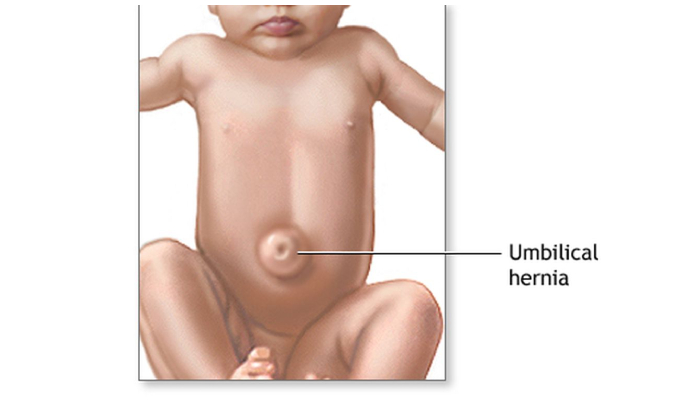
An umbilical hernia occurs when part of your intestine bulges through the opening in your abdominal muscles near your bellybutton (navel). Umbilical hernias are common and typically harmless.
Umbilical hernias are most common in infants, but they can affect adults as well. In an infant, an umbilical hernia may be especially evident when the infant cries, causing the bellybutton to protrude. This is a classic sign of an umbilical hernia.

An umbilical hernia occurs when the opening in the abdominal muscle that allows the umbilical cord to pass through fails to close completely. Umbilical hernias are most common in babies, but they can also occur in adults.
An umbilical hernia in adults usually occurs when too much pressure is put on a weak section of the abdominal muscles. Potential causes include:
Umbilical hernias can usually be seen when your baby is crying, laughing, or straining to use the bathroom. The telltale symptom is a swelling or bulge near the umbilical area. This symptom may not be present when your baby is relaxed. Most umbilical hernias are painless in children. Adults can get umbilical hernias as well. The main symptom is the same — a swelling or bulge near the navel area. However, umbilical hernias can cause discomfort and be very painful in adults. Surgical treatment usually is required.
Umbilical hernias are most common in infants — especially premature babies and those with low birth weights. In the United States, black infants appear to have a slightly increased risk of umbilical hernias. The condition affects boys and girls equally.
In young children, umbilical hernias often heal without treatment. In adults, surgery is usually suggested to make sure that no complications develop. Before choosing surgery, doctors will normally wait until the hernia: